

A client once looked at my Biz Bestie Kathy Booker and me during an engagement and said something that stopped us both in our tracks:
“I love working with you two.”
It wasn’t just a polite compliment. The meeting had moved unusually fast. Complex ideas were clarified in minutes, hard decisions felt surprisingly easy to make, and there was almost zero friction in the room.
Afterward, Kathy and I sat down to figure out why that interaction had gone so well.
Most people would put it down to personal chemistry, good rapport, or simply having two experienced professionals in the room. But as we dissected the conversation, we realized something far more important:
It wasn’t chemistry. It was distribution.
What Was Actually Happening: The Power of Balanced Strengths
In that meeting, our cognitive, decision, and relational strengths were distributed across two people in a way that made the work flow naturally instead of competing for space.
Looking at our motivational gift mixes through the myGiftsID™ Framework:
- Dr. Lisa’s Gift Mix: Teacher – Administrator – Exhorter
- Teacher [Mind]: Systematizing concepts, analyzing data, and grounding logic.
- Administrator [Mind & Will]: Organizing structure, setting sequence, and driving execution.
- Exhorter [Mind & Emotion]: Encouraging action, framing growth, and mobilizing people.
- Dean Kathy’s Gift Mix: Exhorter – Perceiver – Administrator
- Exhorter [Mind & Emotion]: Calling forth potential, lifting energy, and bridging perspective.
- Perceiver [Will]: Spotting incongruities, discerning truth, and maintaining alignment.
- Administrator [Mind & Will]: Keeping momentum aligned to strategic outcomes.
Because our gifts complemented each other, no single domain was overloaded:
- Thinking Flowed: My Teacher gift provided structural clarity, while Kathy’s Perceiver gift rapidly stress-tested the truth of what we were seeing.
- Decisions Moved Quickly: Our shared Administrator capacity provided clear execution paths without ego battles.
- Relationships Stayed Stable: Our dual Exhorter strength kept the client feeling supported, inspired, and safe to engage.
The system worked because contribution was distributed.
The Gift Distribution Model
That realization led to what I call the Gift Distribution Model inside the myGiftsID™ Framework.
Healthy, high-performing teams naturally distribute contribution across three core psychological and operational domains:
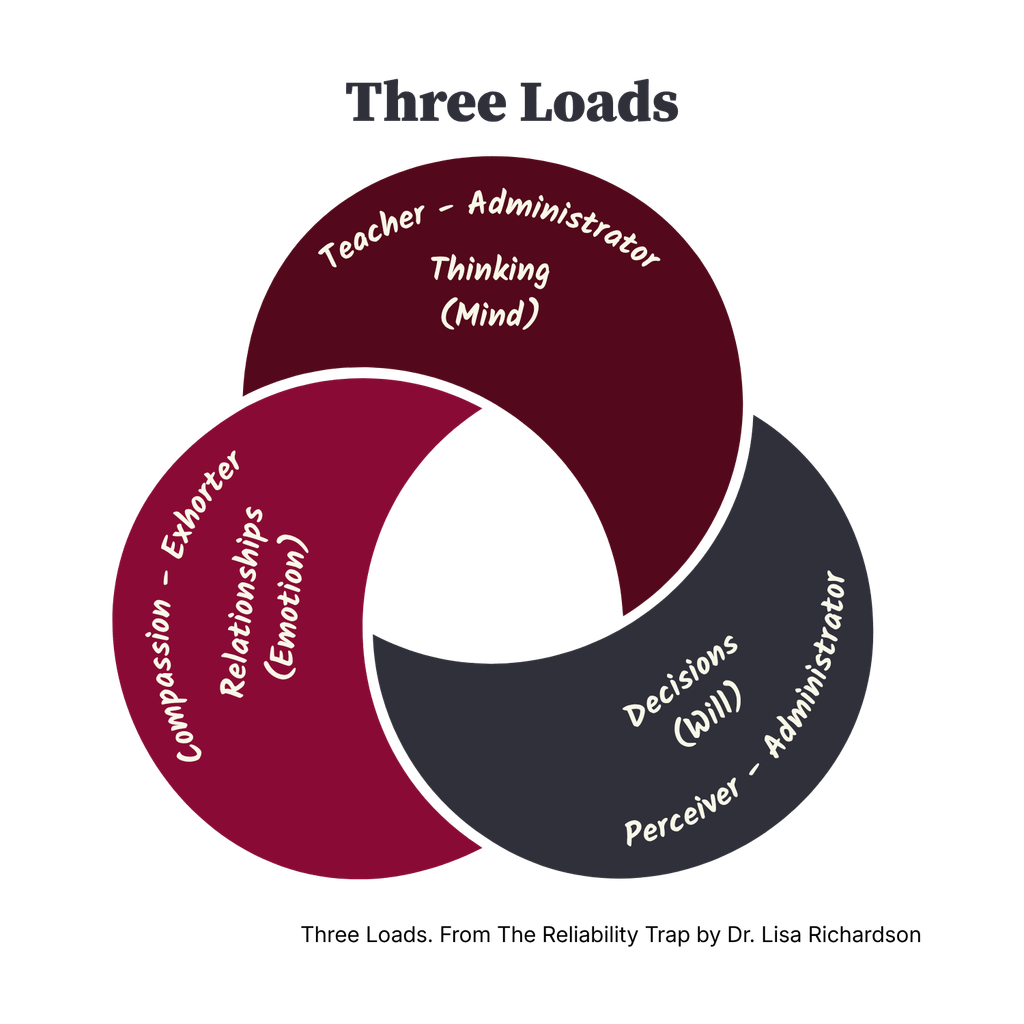
- Thinking (Mind): Problem-solving, research, framework creation, and operational logic (e.g., Teacher, Administrator).
- Decisions (Will): Authority, discernment, strategic direction, and boundary enforcement (e.g., Perceiver, Administrator).
- Relationships (Emotion): Team morale, conflict resolution, client care, and emotional buffering (e.g., Compassion, Exhorter).
When these three loads are distributed across multiple people on a team, work moves with high speed and low friction. Everyone operates out of their natural strength zone without being forced to overfunction outside their wiring.
What Happens When Distribution Breaks
As we studied more organizations, departments, and leadership teams, we noticed the opposite pattern happening far more frequently.
Instead of intentionally distributing work across these three domains, organizations default to Reliability Routing. They identify one or two dependable high performers—their “pillars”—and start funneling pressure straight to them.
At first, it looks efficient. The superstar answers every hard question, fixes every broken process, approves every decision, and smoothes over every team conflict.
But over time, Contribution Concentration takes over:
- Cognitive Load Concentrates: The pillar becomes the only person who understands how the system works.
- Decision Load Concentrates: The pillar becomes the sole escalation point, creating an operational bottleneck.
- Relational Load Concentrates: The pillar absorbs all the emotional strain and team friction.
Instead of three domains carried by a well-balanced team, you have one person carrying all three loads on their own back.
The Bridge to Organizational Risk: The Reliability Trap
Here is the strategic line every leader needs to remember:
When contribution stops distributing, capacity becomes fragile.
This concentration of work leads straight into The Reliability Trap.
The organization misdiagnoses this concentration as “high performance” or “great dedication.” In reality, they have substituted one person’s memory and energy for functional operational infrastructure.
The team appears productive right up until that single pillar experiences burnout, takes extended medical leave, or resigns. When that happens, the system doesn’t just lose an employee—it loses its thinking, its decision authority, and its relational stability all at once.
Summary & Key Takeaway
- Strong teams distribute strengths. They map who is wired for thinking, deciding, and relating, ensuring no single individual carries every domain alone.
- Fragile systems concentrate responsibility. They route pressure toward the most reliable person until the pillar cracks under the weight.
If you want to protect your best people and build an operation that lasts, stop asking one person to carry the whole building.
