
The Reliability Trap Model
The Problem and Organizational Risk of leaning too hard on your most dependable people.
The Problem
Do you know this team?
Productivity is high, projects move smoothly, and one or two stellar performers make it all happen. They’re the ones who can pull key sales reports from a stubborn system, turn an angry customer into a loyal one, or settle the team conflict that’s been making everyone dread Monday mornings.
In a small business, that star performer is often the owner. You built the company, so naturally, you’re the person who knows how everything works. In larger organizations, it’s the employee every manager wants on their team. They’re dependable, they solve problems, and their results make the manager look good.
But here’s the problem: When too much of the business depends on one or two people, their reliability can hide just how fragile the operation has become.
If one of those people suddenly became unavailable for three weeks, what would stop working?

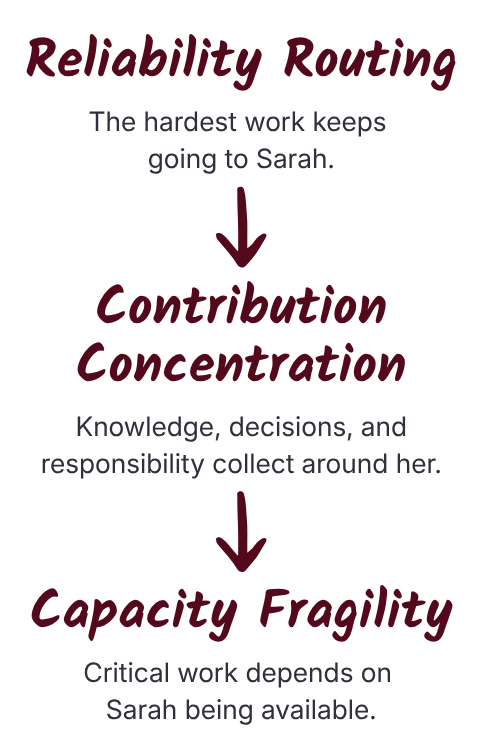
The Pattern
It starts with praise.
“I don’t know what we’d do without Sarah. She’s a rock star!”
Sarah is reliable, thoughtful, and consistently delivers great results. When unexpected challenges pop up, you know she’ll handle them.
So when the next big project comes along, you choose Sarah first. She deserves the opportunity to shine. And when that client calls with another problem, you send them to Sarah, too.
Over time, more work, knowledge, and decisions land on Sarah’s desk. Meanwhile, other team members have fewer opportunities to learn how to handle those challenges themselves.
What began as recognition becomes a pattern of dependency.
That’s the Reliability Trap: reliability attracts responsibility until one person’s capacity becomes the team’s operating system.
The Three Loads
The Reliability Trap isn’t just about giving your best people too many tasks.
It’s about concentrating three kinds of responsibility—thinking, decision-making, and relationship management—on the same few shoulders. Much of this work never appears in a job description, but it can consume hours of someone’s day.
| Load | What it looks like | Example |
|---|---|---|
| Cognitive | One person holds critical knowledge and solves unusual problems. | Brenda is the go-to for software glitches, trade show layouts, and last-minute reports. Nobody else knows where to start. |
| Decision | Work stalls until one person approves it. | A client needs an urgent scope change the team can deliver, but only owner Marcus can approve it—and he’s off-site. |
| Relational | One person absorbs conflict and keeps everyone steady. | Sarah becomes the team’s unofficial counselor. Colleagues stop by to unload, leaving her little time for her own work. |

The Breaking Point
It starts with a perfectly reasonable delay.
Sarah needs another day or two to finish a project. She’s been carrying so much lately, and nobody else can deliver quite like she does. So the team adjusts the deadline.
Then another project stalls because Sarah hasn’t had time to review it. A customer waits for an answer only Sarah knows. Other employees hold off on making decisions until she can weigh in.
And then Sarah calls in sick.
She’s still sick the next day. And the next.
Now deadlines are slipping, customers are calling back, and the manager is digging through old emails trying to figure out how Sarah handles work nobody else has learned to do.
The business hasn’t lost its best employee. She’s just unavailable—and critical work is already falling apart.
That’s Capacity Fragility.
When too much knowledge, responsibility, and authority rest with one person, even an ordinary absence can disrupt the operation. And if that person leaves permanently, the business may have to rebuild workflows, recover customer relationships, and train a replacement while trying to keep the doors open.
The Leadership Shift
Leaders have to look beyond today’s impressive results and ask whether those results can continue without the same people carrying the weight.
That takes courage. When Sarah consistently delivers, changing how the work gets done can feel like interfering with success. But a team that depends on Sarah’s constant availability isn’t as strong as its performance reports suggest.
The leadership shift is to stop treating your most dependable people as unlimited capacity—and start building a team that can share the thinking, decisions, and relationships required to keep work moving.
But you can’t repair a load-bearing wall by pulling out the supports.
Protect the pillar before you redistribute the weight.
Before asking Sarah to document every process by Friday or train Michael to take over half her responsibilities, give her some breathing room. Then examine where the work, knowledge, and decision-making authority have become concentrated.


Different people are drawn to different kinds of work. Good leadership recognizes those patterns without letting willingness become unlimited responsibility.
The Deeper Framework
Redistributing responsibility isn’t as simple as moving tasks from Sarah’s desk to Michael’s.
Leaders also need to understand why certain people keep becoming the team’s default problem-solvers, decision-makers, and peacekeepers.
Before you move the work, understand what keeps drawing people to it.
Through my work with BestieFinder and the myGiftsID™ framework, I examine how people’s natural motivations—what we call their Motivational Gifts—influence the ways they contribute to a team.
Gift Intelligence (GiftIQ) is the ability to recognize your own and others’ Gifts and understand how different Gift Mixes can work together—or create friction.
For leaders, this adds another lens to workload and capacity planning. Understanding someone’s Gift Mix can help explain why they repeatedly step into certain roles, while revealing opportunities for others to contribute in different ways.
Combined with a clear look at skills, decision authority, and how work actually moves through the organization, intentional Gift Distribution can help leaders build teams that share cognitive, decision, and relational responsibilities—without simply creating another Sarah.
How Leaders Use This Model
How do you know if you have a Sarah?
Start with a simple diagnostic: If one or two of your most dependable people were unavailable for the next two weeks, which projects, critical processes, or team responsibilities would stop?
Once you’ve identified where the business depends too heavily on particular people, you can begin reducing that dependency before something breaks.
But don’t rush to take responsibilities away. To a high performer who’s spent years earning your trust, suddenly reassigning their work may feel less like relief and more like a demotion.
That’s why you protect the pillar first. Acknowledge what they’ve contributed, explain the risk of having so much depend on one person, and involve them in building a team that can share the responsibility.
I recommend the Capacity Protection Sequence:
Step 1.
Protect the overloaded pillar.
Remove unnecessary interruptions and create room to breathe.
Step 2.
Add relational support and stabilization.
Make sure one person isn’t responsible for managing everyone’s concerns and conflicts.
Step 3.
Redistribute cognitive load.
Help others learn the critical processes, troubleshooting steps, and knowledge held by one person.
Step 4.
Redistribute decision authority.
Give trained team members permission to make appropriate decisions without waiting for one person’s approval.
Strong teams don’t eliminate the weight. The work still has to get done.
They distribute it.

Bring This Framework to Your Organization
If you own a growing business where too many decisions still depend on you—or manage a team where everyone turns to the same one or two people when things get complicated—the Reliability Trap may already be affecting your ability to grow.
I work with business owners, managers, and leadership teams to identify where critical knowledge, decisions, and responsibilities have become concentrated, then build a practical path toward sharing that load.
Ready to find out where your business is most vulnerable?
Explore the Key Person Risk Review to identify the people, processes, and decisions your operation depends on most.
Planning a leadership event or manager development session?
Bring The Reliability Trap or Stop Breaking Your Heroes to your audience through a keynote, workshop, or facilitated conversation.