
What Your Employees and Customers Learn From the Way Your Business Actually Runs
The Brand Promise Wasn’t the Problem
I spent years helping business owners improve how they communicated with customers. Sometimes that meant building a better follow-up process, cleaning up a CRM, or helping them explain what made their business worth choosing.
Every so often, a client would come to me convinced that their primary problem was top-of-funnel messaging. They wanted a sleek email nurture sequence, a sharper elevator pitch, or an automated lead-tracking system to fix their leaky bucket.
So we would audit the system—and that’s when the real picture emerged.
The new email sequence would go out, leads would come in, and then… absolute silence. Customer inquiries sat unanswered for days because every custom response required the owner’s personal seal of approval. Or a critical follow-up would evaporate into thin air because three different team members assumed someone else owned the next step.
The problem wasn’t the message. The problem was what happened after someone responded to it.
When your marketing promises speed, responsiveness, and seamless care, but your internal operations produce delays, confusion, and bottlenecked decisions, the marketing isn’t driving growth—it’s just exposing a structural fault line.
Your Operations Are Making Promises, Too
We tend to think of “branding” as a conscious creative exercise: logo design, tagline polish, mission statements, and curated social copy. That is your Intentional Brand—what you intend to deliver.
But every single day, your business is communicating something else entirely.
Your Operational Brand is what employees, customers, and partners learn they can expect from your business based on how it consistently operates.
Marketing communicates intention; operations dictate reality. And when those two forces collide, reality wins every single time.
Your culture is what your operations teach people to expect.
If your operational habit is to let client emails sit while managers scramble for approvals, your operational brand is unreliable. If your operational habit is to let a single employee carry every difficult customer escalation while the rest of the team stands by, your operational brand is fragile.
You don’t get to choose whether or not you have an Operational Brand. You only get to choose whether it’s the one you intentionally built—or the one that formed by default.
Your Employees and Customers Are Learning From the Same Systems
The most dangerous myth in business management is that internal operations remain safely hidden behind the curtain. Leaders assume that as long as they put on a polite face for the client, internal operational friction won’t leak outward.
It always leaks. Your employees and your customers are observing the exact same operating habits—they are simply experiencing them from opposite sides of the counter.
| Operating Habit | What Employees Learn | What Customers Learn |
|---|---|---|
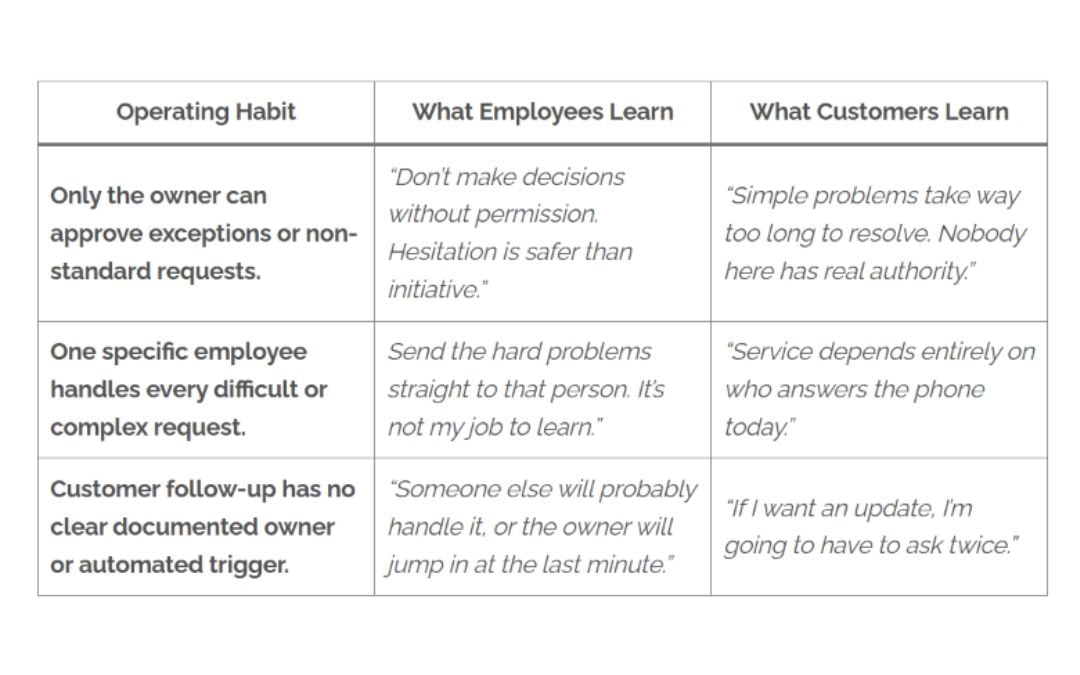
| Only the owner can approve exceptions or non-standard requests. | “Don’t make decisions without permission. Hesitation is safer than initiative.” | “Simple problems take way too long to resolve. Nobody here has real authority.” |
| One specific employee handles every difficult or complex request. | Send the hard problems straight to that person. It’s not my job to learn.” | “Service depends entirely on who answers the phone today.” |
| Customer follow-up has no clear documented owner or automated trigger. | “Someone else will probably handle it, or the owner will jump in at the last minute.” | “If I want an update, I’m going to have to ask twice.” |
Notice the pattern? One structural gap creates two distinct, negative experiences. An operational system that stifles employee agency simultaneously erodes customer trust.
When Your Best Employee Becomes the Operating System
This is the exact entry point where operational friction matures into enterprise risk.
When a business lacks clear operational routing, it defaults to Reliability Routing. Instead of building a system, training the team, or clarifying decision rights, the business starts routing every complex issue, stalled project, and demanding client to the same dependable person—let’s call her Sarah.
Because Sarah is competent and efficient, she figures it out.
Over time, the company teaches employees to depend on Sarah. Customers learn to skip the main inbox and ask for Sarah by name. Managers fall into the comfortable trap of mistaking Sarah’s extraordinary personal endurance for a functional business process.
This is how Contribution Concentration takes root. Critical cognitive load, decision authority, and client trust accumulate around one pair of shoulders.
When customers trust Sarah more than they trust your process, you have a structural risk that a better marketing campaign won’t fix. You haven’t built an operational brand; you’ve built a single-point dependency. And the second Sarah takes a vacation, experiences burnout, or receives an offer from a competitor, your “brand” grinds to a sudden, painful halt.
The Human Element: Why the Work Keeps Finding the Same People
To fix this, we have to recognize that work doesn’t concentrate around people purely by accident.
Every human being brings a distinct motivational wiring, strength mix, and operational habit to work. Through my work with BestieFinder and the myGiftsID™ Framework, I’ve spent years studying how Motivational Gifts and Gift Mixes influence contribution patterns inside teams.
Some people are naturally wired with a Server or Administrator gift mix—they instinctively step toward chaos, create order, and fix broken problems before anyone asks. Others are wired for Compassion or Exhorter roles, naturally absorbing relational friction and team morale.
When leaders understand Gift Distribution, they gain a vital diagnostic lens for why responsibilities keep moving toward certain people.
However, a critical distinction must be made: Gift Mixes should inform development and capacity building—never structural exploitation.
Recognizing that Sarah has a natural gift for administrative execution isn’t a license to dump the department’s entire decision load on her desk. The goal of understanding team wiring is to build complementary capacity across the entire system, ensuring that natural willingness isn’t punished with infinite responsibility.
Three Questions That Reveal Your Operational Brand
If you want to audit what your business is actually teaching your employees and customers to expect, sit down with your leadership team this week and examine these three diagnostic questions:
1. What do people have to wait for?
Look closely at your workflows. Where do approvals, answers, handoffs, or routine decisions regularly grind to a halt? If work stalls every time a specific leader steps out of the office, your operational brand is teaching your team that autonomy is dangerous and teaching your clients that speed is conditional.
2. Who do people automatically go to when something gets complicated?
Identify the informal “heroes” in your organization. Who is carrying the unwritten institutional memory, the unmapped client context, or the sole authority to fix a mess? If the answer is consistently the same one or two people, you are looking at concentrated capacity risk.
3. What happens when that person isn’t available?
Trace the downstream impact of a 3-week absence. Do projects pause? Do customer emails go unacknowledged? Does the rest of the team stand around waiting for direction? The answer to this question reveals the true gap between your marketing promises and your operational reality.
Build a Business That Can Keep Its Promises
A better CRM, a sharper brand identity, or an automated email sequence can certainly help you deliver a message faster. But technology cannot give employees authority they haven’t been granted, and software cannot create backup capacity that doesn’t exist.
A business grows reliably when its people, decisions, communication, and processes can organically support the promises it makes to the market.
You don’t have to wonder what your business is teaching people to expect. Look at what happens when a customer has an emergency, an employee needs a routine answer, or your most dependable person takes a week off.
Your Operational Brand is already taking shape in those moments.
The only question is whether it’s the one you intended to build.
Next Steps for Leaders
If you are concerned that your business has quietly built an Operational Brand rooted in single-expert dependency, it’s time to map your concentration risk before the pillar cracks.
Explore how a Key Person Risk Review can help you protect your best people, distribute critical load, and build a resilient system that keeps its promises.
